The Farmer's Carry Guide: Build Grip, Core & HYROX-Ready Strength
Grip strength predicts mortality better than blood pressure (Lancet, 2015). Here's how to master farmer's carry technique, variations, and HYROX standards.



Grip strength predicts mortality better than blood pressure (Lancet, 2015). Here's how to master farmer's carry technique, variations, and HYROX standards.
Grip strength sounds like a gym-bro stat until you see the data: it out-predicts systolic blood pressure for cardiovascular death (Leong et al., The Lancet, 2015). If you've ever dropped a barbell mid-deadlift or watched your kettlebell swing tumble out of your hands during a WOD, you already know grip is the silent limiter behind a lot of failed lifts.
The farmer's carry fixes that with almost zero technical risk. Pick up two weights, walk, put them down. That simplicity is exactly why it's underused, and exactly why it belongs in every CrossFit and HYROX athlete's program.
This guide covers the setup, the three variations worth training, and how the movement is standardized inside HYROX races, so you can train it with a purpose instead of tacking it onto the end of a session as an afterthought.
The farmer's carry is a loaded carry performed by walking a set distance while holding weight in each hand. It can be done with dumbbells, kettlebells, trap bars, or dedicated farmer's carry handles, and it demands almost no coaching to execute safely.
The exercise is a direct match for CrossFit's core-to-extremity movement pattern. Your midline (torso, hips, glutes) has to stay rigid so the force your legs generate can transfer cleanly out to your arms and grip. That same transfer underlies barbell cycling, ring work, and heavy overhead lifts, which is why a stronger midline shows up as better performance almost everywhere else in your training.
Reduced grip strength is one of the strongest predictors of all-cause and cardiovascular mortality identified in a 17-country study of nearly 140,000 adults (Leong et al., The Lancet, 2015). Researchers found grip strength outperformed systolic blood pressure as a mortality predictor, which is a striking result for such a simple measurement.
For fitness athletes, the practical translation is more immediate: your grip typically fails before your back, shoulders, or legs do. A stronger, more fatigue-resistant grip means you hold onto the bar longer during muscle-up work, cycle kettlebells and dumbbells without breaking pace, and finish HYROX stations without your forearms giving out first.
Carries also reinforce anti-extension and anti-lateral-flexion core stability, the same qualities you rely on during heavy squats, thrusters, and handstand work. Because the load is light relative to a max-effort deadlift, farmer's carries let you build that stability with far less injury risk than most heavy barbell accessory work.
Set up and execute the carry in this order:
The single most important cue: brace before you lift, and re-brace every time you set the weights down and pick them back up. Most technique breakdowns happen on the reset, not the walk.
Three variations cover most of the weaknesses a straight farmer's carry can't reach on its own.
Suitcase carry. Hold the load in one hand only. Your core has to fight rotation instead of just flexion, which builds the kind of unilateral stability that transfers to single-arm dumbbell work and asymmetric lifts.
Overhead carry. Press one or two weights overhead and walk while keeping your arms locked out by your ears without arching your back. This variation is closer to a shoulder-stability drill than a grip drill, and it directly carries over to handstand lockout and overhead barbell positions.
Bear hug carry. Wrap your arms around a sandbag, keg, or D-ball and walk while squeezing the load into your chest. This is the best of the three for raw trunk stiffness and anti-rotational bracing, and it hits your forearms, biceps, and posterior chain harder than either of the other two.
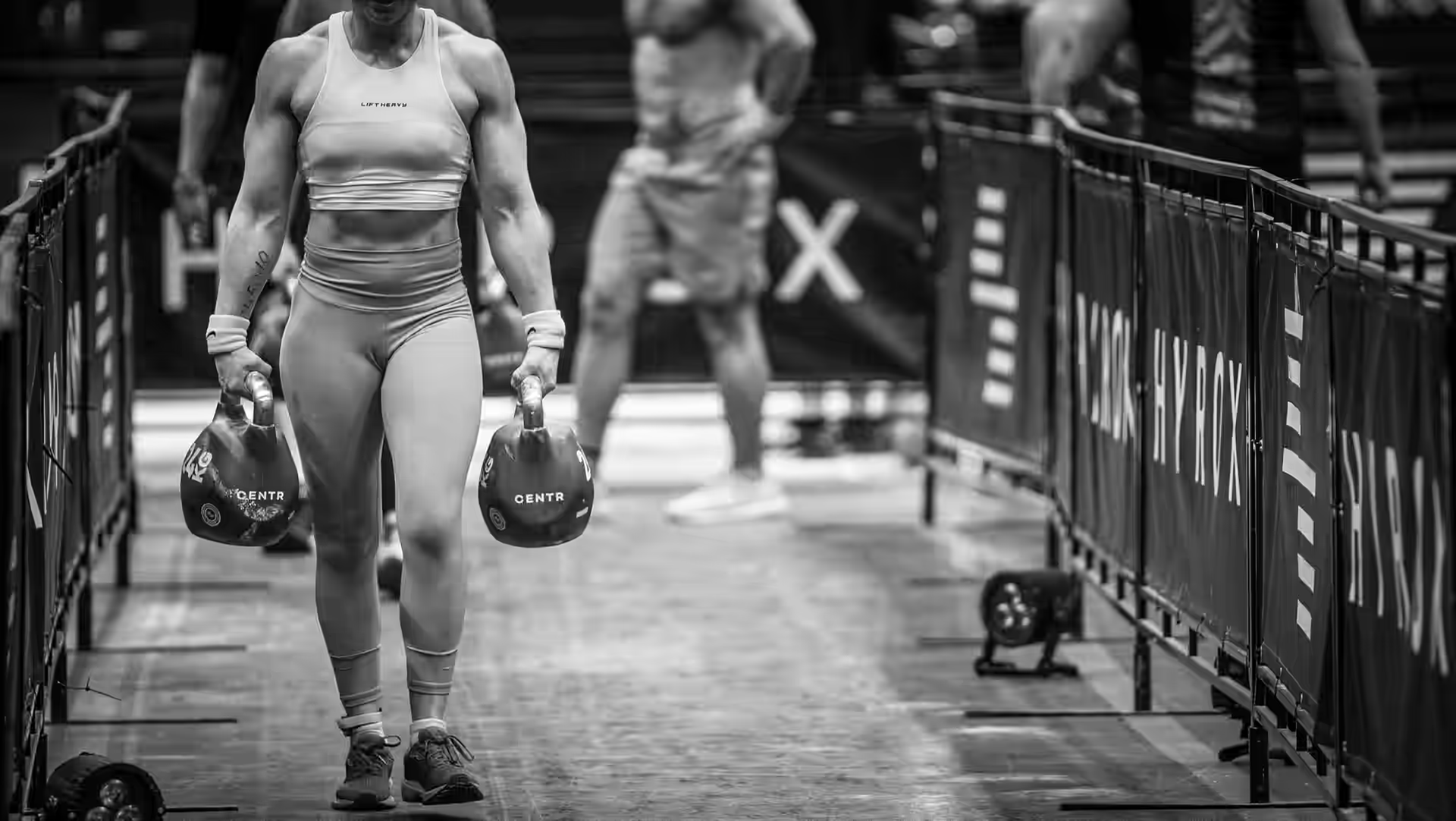
HYROX places the farmer's carry as station six of eight, immediately after four rounds of running and functional work, and standardizes both the distance and the load by division (HYROX, 2026):
Division: Women
Distance: 200 m
Kettlebell Load: 2 x 16kg
Division: Women Pro
Distance: 200 m
Kettlebell Load: 2 x 24kg
Division: Men
Distance: 200 m
Kettlebell Load: 2 x 24kg
Division: Men Pro
Distance: 200 m
Kettlebell Load: 2 x 32kg
Athletes can break the carry into as many segments as they want, but the kettlebells must stay exactly where they're set down. Our companion breakdown, the HYROX Farmer's Carry Tutorial, goes deeper into the full rulebook and pacing strategy, including the "short but quick" breaking pattern that keeps your forearms from hitting failure mid-station. If you're building a full race plan, start there once you've got the base movement pattern down from this guide.
Letting the shoulders round forward. This happens when athletes rush the pickup instead of hinging properly, and it turns a low-risk exercise into a real strain risk for the upper back. Reset your shoulders down and back before every step.
Taking long, bouncing strides. Long steps feel faster but cause the weights to swing, which burns extra grip energy fighting the sway instead of just holding on. Short, quiet steps are almost always faster over distance.
Skipping carries entirely because they feel "boring." Carries don't need to be exciting to be effective. They're one of the highest return, lowest risk accessory movements available, which is exactly why they're worth programming even when nothing about them feels like a PR.
Only training the double-overhand grip. If every carry you do uses the same grip, you're leaving strength-endurance on the table. Rotate between a false (deep palm) grip and a neutral grip in training so your forearms don't hit a wall the first time your standard grip fatigues on race day or in a long WOD.
Treat carries as accessory work, not a warm-up filler. A simple structure that works for most CrossFit and HYROX athletes:
For race-specific conditioning as you approach a HYROX event, mix carries into interval work rather than training them in isolation. A simple example: 3 rounds of a 400m run at race pace, 100m farmer's carry at race weight, another 400m run, then 2 minutes of rest. This teaches your grip to fire under the same fatigue you'll feel on race day.
Start with a load you can carry 20 meters unbroken with good posture, then add weight once you can comfortably clear 40 meters. For HYROX-specific prep, train at or slightly above your division's prescribed kettlebell weight so race day feels lighter by comparison.
Carries are generally low-risk because the load stays close to your body, but you should master a pain-free deadlift and squat pattern first. If bracing and walking with light weight causes pain, address the underlying issue with a coach before loading further.
A farmer's carry loads both hands evenly, training bilateral grip and posture. A suitcase carry loads one side only, forcing your core to resist lateral flexion, which makes it the better choice for correcting side-to-side imbalances.
A stronger grip and midline mean you spend less time re-gripping barbells, kettlebells, and gymnastics rigs, and you hold pace through the farmer's carry station instead of stopping repeatedly. Over a full workout or race, those saved seconds compound.
No. Any pair of dumbbells or kettlebells you can grip evenly works. Farmer's carry handles and trap bars are useful once you're loading heavier than your equipment allows to hold comfortably, but they're not required to start.
The farmer's carry rewards consistency more than intensity: a few unbroken sets, two or three times a week, build the grip and core stiffness that show up everywhere else in your training. Add one variation, suitcase, overhead, or bear hug, to target your specific weak point, and you'll notice the carryover in your lifts, your gymnastics, and your race pacing within a few weeks.
If you're training toward a HYROX event, pair this guide with our full HYROX Farmer's Carry Tutorial for race-day pacing strategy, or check out our HYROX training program for a complete build.

John Singleton, the founder of The Progrm, is known for training elite athletes, including many of Europe’s top CrossFit Games competitors. With a Master’s degree in Osteopathy, John combines science-based programming with a focus on performance and recovery. Based in Mallorca, Spain, he leads a global community dedicated to helping athletes optimize performance and longevity in the sport.